
Home / Warehouse clocks
Warehouse QC, returns and storage: check before dispatch
Before a parcel ever leaves Xiamen, three clocks decide what you can still undo cheaply. This is where a problem is a return rather than a claim.
Five days is 120 hours, from the next full hour
Oopbuy's returns page is precise about this. You can request a return or exchange within five days after the order status changes to Stocked in, and those five days are counted as 120 hours starting at the next full hour after the status change. An item stocked in at 14:20 on a Monday starts its count at 15:00 and closes at 15:00 on Saturday. A request made after that may not be accepted.
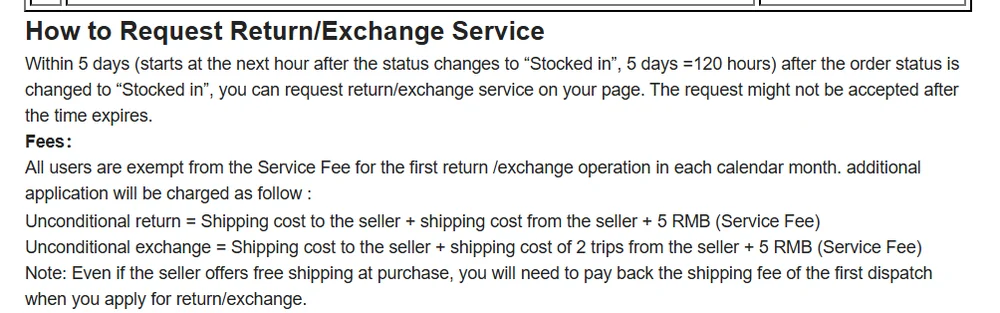
Two conditions narrow the window further. The service only applies to items whose seller offers a guaranteed return, and the item must be fit to resell. The page also lists exclusions: custom-made goods, removed tags, second-hand goods, items from outside mainland China, underwear, adult products, food and some books, among others. You pay the return postage, plus a 5 RMB service fee beyond the first free request each month.
Order statuses and how long each refund takes
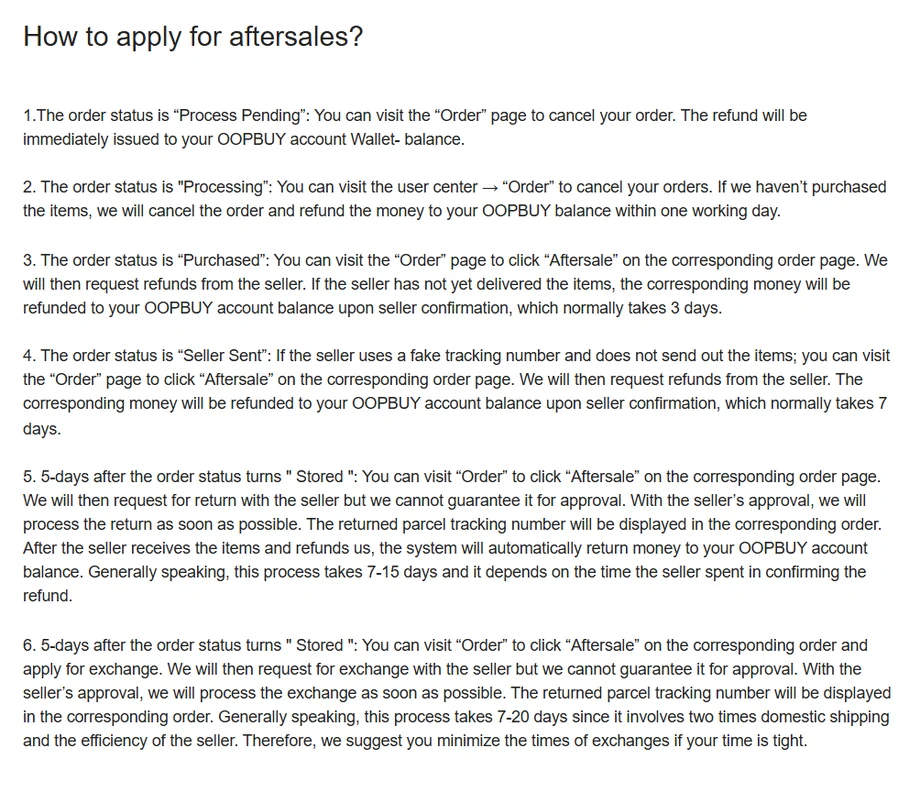
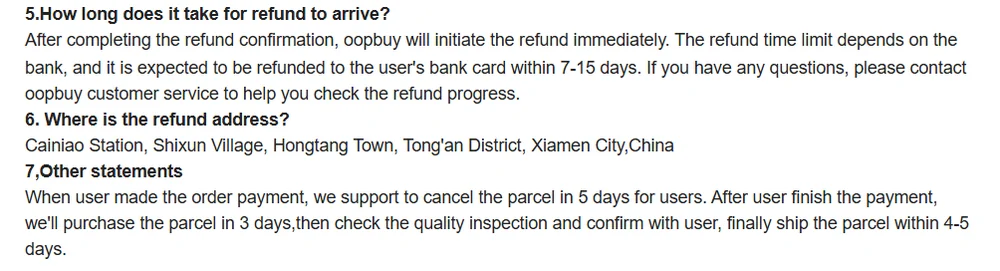
Oopbuy's after-sales page sets out what happens at each status, and every line carries its own clock. Cancel while the order is Process Pending and the refund is immediate. Cancel while it is Processing and, if the item has not been bought, the money returns to your balance within one working day. Once the status is Purchased, a refund depends on the seller and normally takes three days.
If the seller marks the item sent with a fake tracking number, the refund normally takes seven days. A return after Stocked in generally takes seven to fifteen days, and an exchange seven to twenty, because it involves two domestic deliveries. If your time is tight, Oopbuy itself suggests keeping exchanges to a minimum.
QC photos: the last look before dispatch
The official Inspection Information page, checked 18 October 2026, describes incoming opening, quantity, colour, size/label, visible-condition and prohibited-goods checks. Regular QC commonly includes three free photographs; the exact coverage is not guaranteed for every item. Check current charges for extra measurements or detailed photos before requesting them.
For claims, the photos matter in a way the help pages do not spell out. They are the only record of the item's state before it travelled. If a jacket shows a stain in its QC photo, that is a return case now; if the stain only appears in your photos in Manchester, Oopbuy has its own photos to compare against.
Read a real QC photo, then decide
Start with the order record beside the photo. Match the pair or item count, colour and labels. Zoom into seams and surfaces. A top-down view cannot show an insole length, a hidden zip or whether a watch works; request that specific view or service rather than guessing.
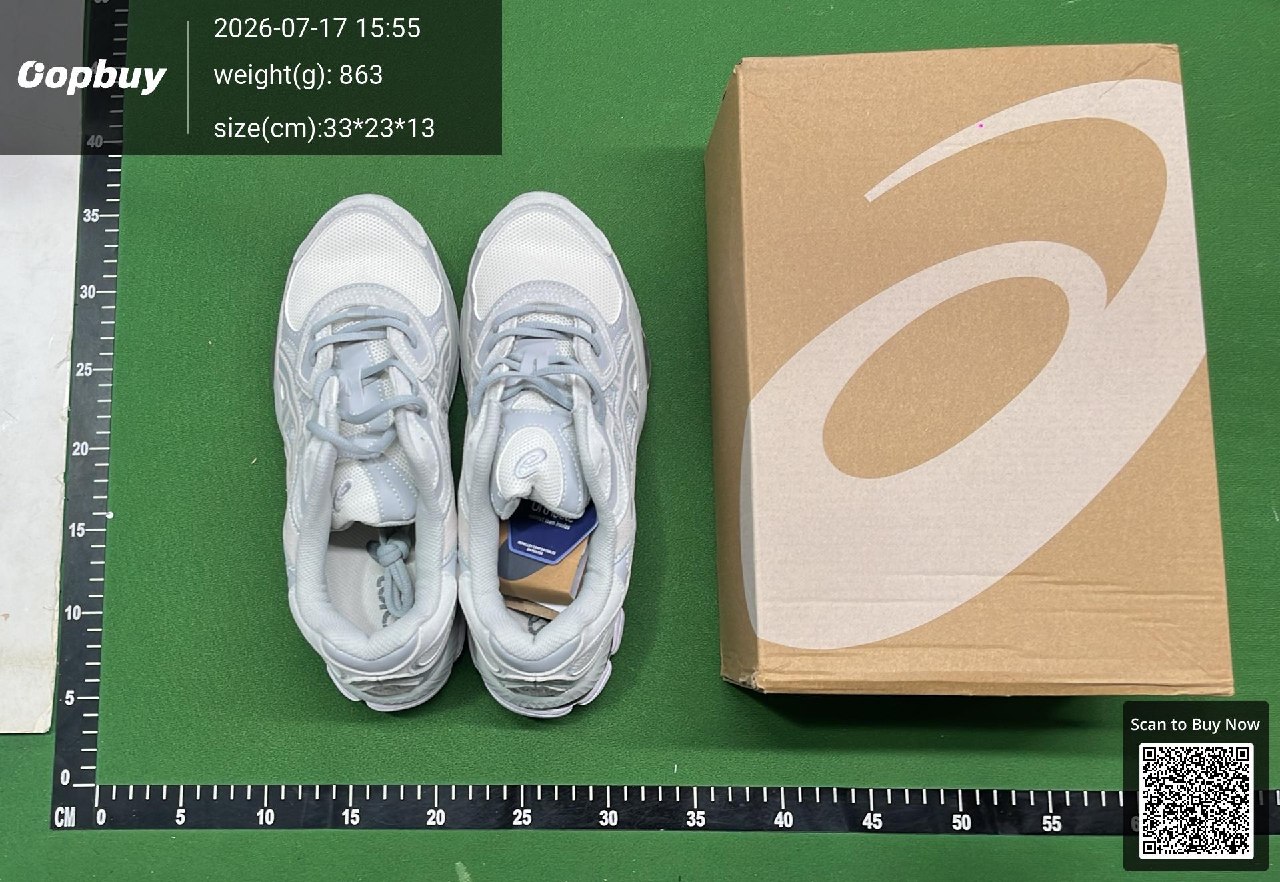
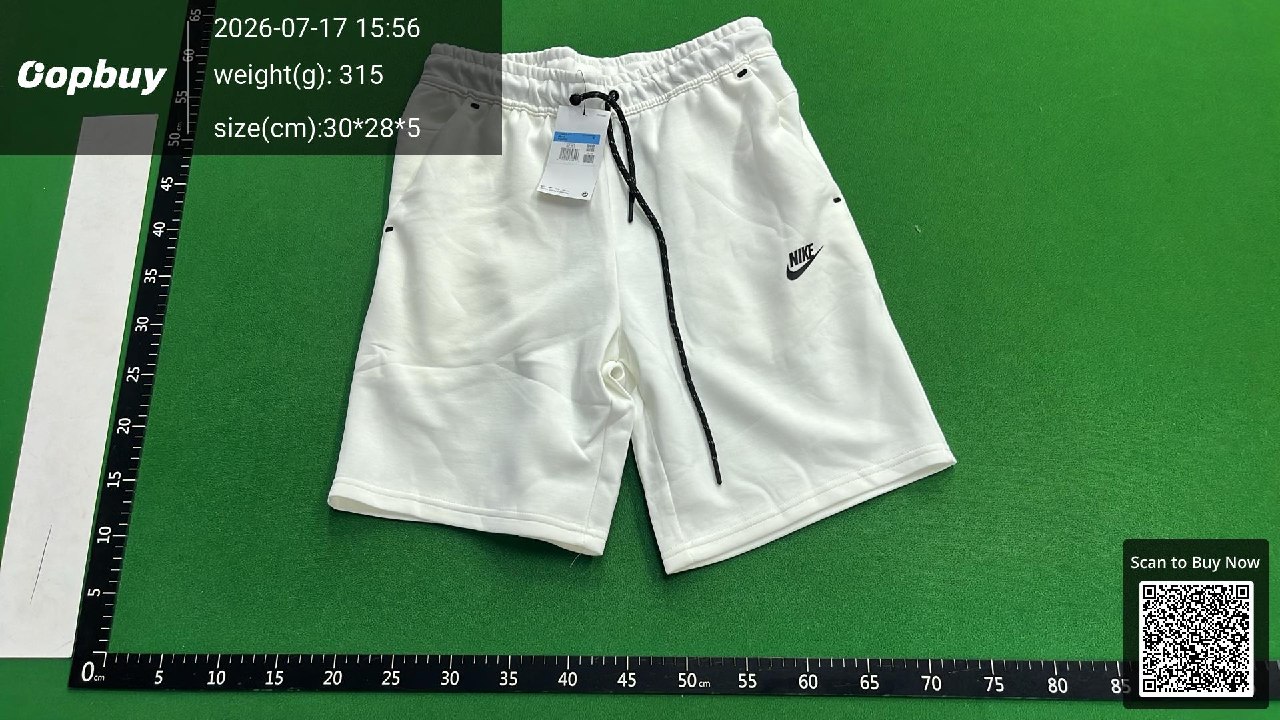
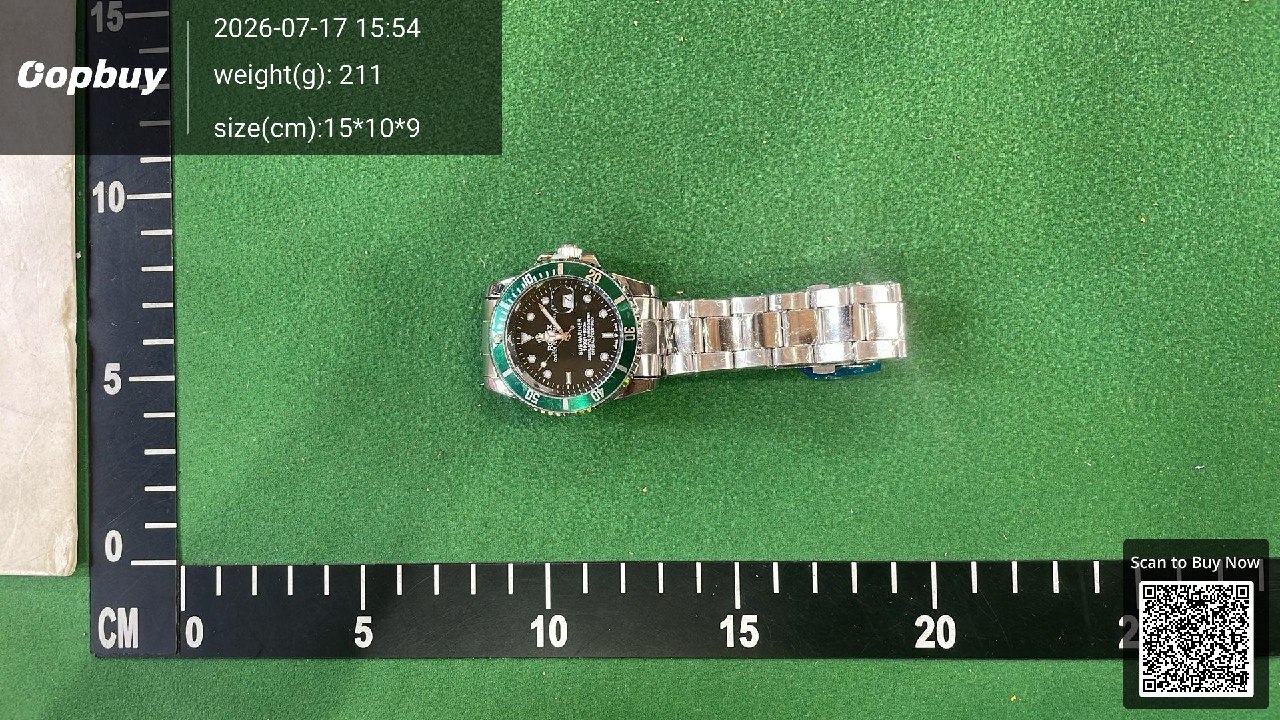
These July 2026 warehouse examples illustrate the checks, not a recommendation to buy those exact items. Standard QC is not authentication, a laboratory test, a guarantee of fit or a complete electronics function test.
Decision: keep an item when the evidence answers the questions that matter to you; request a targeted check when it does not; ask about a return promptly when the item fails your documented requirements. The seller’s eligibility and resalable condition still apply.
How to check QC photos for claim evidence
Read QC photos as if you were preparing for a dispute that has not happened yet. Is the size label visible? If not, ask for a detailed photo while the item is still on the shelf, because a size claim after delivery needs a label photo and a chart that disagree. Does the count match the order? Shortage claims are measured against it.
Look for stains, loose threads and damage, which are return matters, and for the state of any box. A shoebox crushed before dispatch is not transit damage, and you will not be able to argue that it was. Oopbuy's inspection does not cover colour difference, sizing accuracy or how an item performs in use, and electronics are checked by appearance only, with no power-on test.
Ninety days of storage, thirty for abnormal parcels
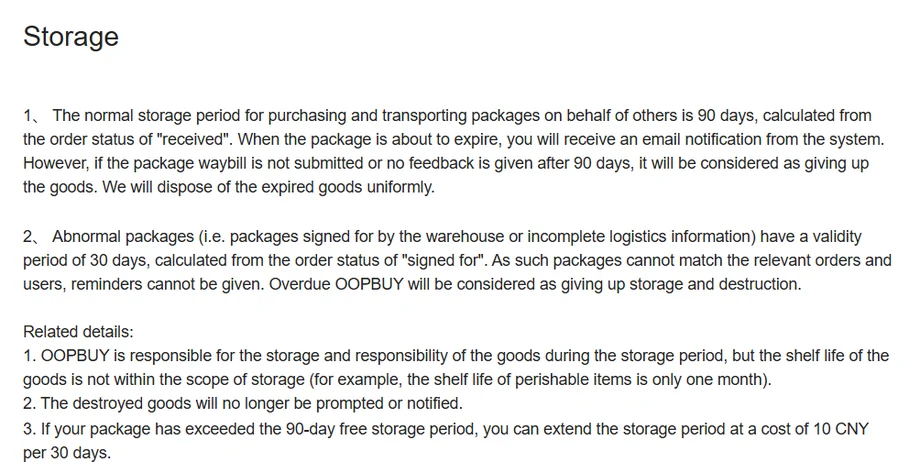
Normal storage is 90 days, counted from the order status Received. Oopbuy emails before it expires; after 90 days without a submitted parcel or feedback, it treats the goods as abandoned and disposes of them. Abnormal parcels, meaning ones signed for by the warehouse that cannot be matched to an order, have 30 days from Signed for, and because nobody can be matched, nobody is reminded.
Extension is possible at 10 CNY per 30 days, according to the storage page. Other Oopbuy pages describe the ceiling differently, so treat the extension window as limited and do not plan around a maximum. The storage promise also excludes shelf life: perishable goods can expire on the shelf without that counting as Oopbuy's loss.
One return window, two ways of writing it
The same returns page describes the window twice. Its opening paragraph frames the seller's rule as seven days after the product is signed for, which it immediately explains as five days after the item is stocked in at the warehouse. The signature in that sentence is the warehouse's, not yours. Then the request section gives the version you actually use: 120 hours from the next full hour after Stocked in.
If you read the seven days as starting at your own doorstep, you will plan for a window that closed weeks before your parcel left China. Use the Stocked in time on your order page, and add 120 hours.
When the warehouse clocks stop
Do not submit an item for international shipping while a return request or QC question is unresolved. Submission and dispatch are different events; ask support whether a parcel can still be cancelled or changed. Check QC, return eligibility, storage expiry and packing instructions before confirming the parcel.
If something is wrong at this stage, the cheapest fix is almost always a return. A refused claim later costs the item and the shipping; a return now costs a domestic delivery and, beyond the free one each month, 5 RMB.
Next on the clock: dispatch day, when the compensation clock starts.
Dispatch day