
Home / Not covered
Outside the cover: Oopbuy's exclusions, line by line
The general compensation page lists exclusions, and individual lines or purchased protection can add their own conditions. Read both before submitting a parcel.
The exclusion list in Oopbuy's words
The Insurance and Compensation page lists seven exclusions. Force majeure, defined as war, natural disasters and radioactive contamination. Claims without proof. Claims past the deadline of seven days after signing or 45 days after shipping, or made after delivery. Parcels stolen or missing after delivery. Non-insurable categories, prohibited or restricted items and goods confiscated by an authority. Loss or damage caused by the customer, deliberately, or by the nature of the product. And other situations that cannot be compensated.
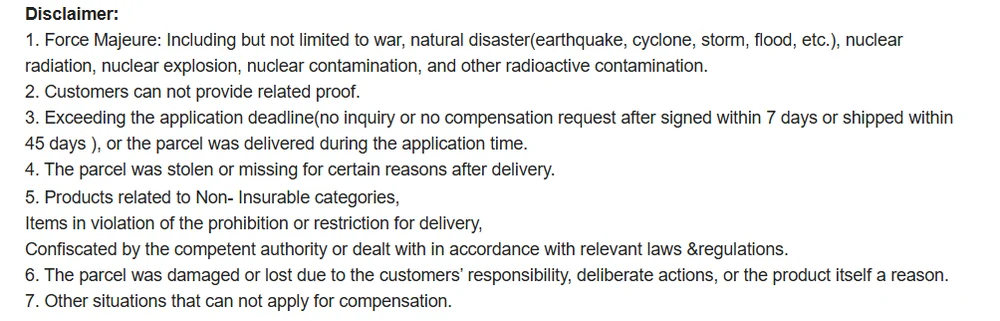
The last line is a catch-all, and you should read it as one: the list is not a promise that everything else is covered. The sections below take the lines that decide most UK claims.
Stolen or missing after delivery
The receiving notes draw the line at a normal signature, and the compensation page excludes parcels stolen or missing for any reason after delivery. In the UK, delivery is often completed without you: a neighbour, a safe place, a porch. Each of those is a delivery.
The cover question then moves away from Oopbuy entirely, towards the carrier's own process and, for theft, the police. If parcels go missing on your street, change the delivery arrangement before you ship, not after.
Intact box, same weight, item missing
Oopbuy's international parcel delivery agreement lists cases in which it pays nothing on parcels without protection. One of them surprises people: if the packaging is intact with no sign of opening, and the weight has not gone down, but the contents are short or damaged, no compensation is given.
The reasoning is that an unopened, full-weight parcel points to a problem before packing rather than in transit. Your defence is the warehouse record. If the QC photos show the item and the parcel photo shows it packed, say so and attach them. If you did not buy the parcel photo, this is the case where 5 RMB would have helped.
Fragile goods: loss is covered, damage is not
The receiving notes' exemption clause opens with fragile goods: fragile and vulnerable items, whether or not the packaging was strengthened, are only covered for loss, not damage. Dangerous goods and contraband are excluded altogether. Natural wear, inherent defects and price changes are not claimable, nor is loss from natural disasters in transit.
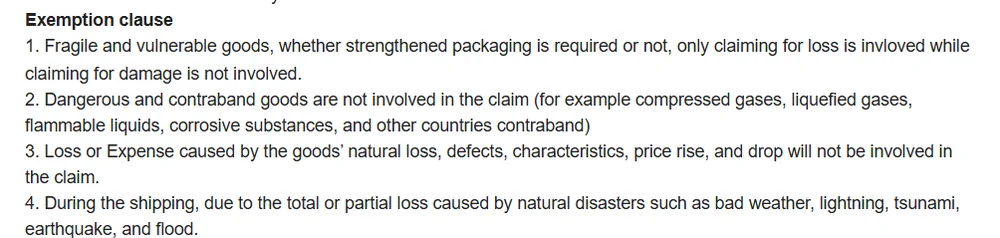
Paying for extra packaging does not move a fragile item into the damage cover. If a glass item matters, the decision is whether to ship it at all.
Prohibited, restricted and infringing goods
Items that break shipping rules are outside every plan, and so are goods confiscated by an authority and dealt with under its own law. Oopbuy's receiving notes add that it checks material and category but cannot verify whether goods are genuine, and that if items are judged to be fakes or sensitive and the parcel is confiscated, the responsibility is yours.
The Shopping Guidelines prohibit counterfeit and infringing goods and describe possible warehouse disposal without refund. A catalogue listing or QC photo does not establish compliance or authenticity. Check the actual goods and applicable restrictions before purchasing.
Your own part of the bargain
Several exclusions are about the recipient. Loss caused by a recipient error, such as a wrong address or a failed delivery, is excluded from loss cover. A parcel returned to the carrier's overseas warehouse or destroyed because you did not sign for it in time is excluded. Delay or seizure caused by not cooperating with customs or not paying tax is excluded from both delay and seizure cover.
These are conditions in the retained protection notes. Check how they apply to ordinary delivery situations: a missing flat number, travel during the delivery week, or a customs bill requiring a response.
Force majeure and the peak season
Force majeure appears twice. The compensation page names war, natural disasters and nuclear or radioactive contamination as excluded. The Delay Protection note names extreme weather, war and strikes, and says these lead to partial compensation or exemption depending on the circumstances.
Neither page lists the October to January peak as force majeure. Peak has its own rule, ten extra working days on every delay mark, explained on the late parcels page.
Making sure you are inside the cover
Reduce avoidable problems before shipping: use accurate order and address records, request useful evidence, choose a delivery arrangement you can manage and respond to customs promptly. These steps improve the record; they do not guarantee coverage or prevent every refusal.
If a claim is refused, ask customer service which line of the exclusions it relied on, in writing. A refusal tied to a named line is something you can check against the page; a refusal without one is worth questioning.
Next: UK customs, where a different set of deadlines applies.
UK customs