
Home / Late parcels
Late Oopbuy parcels: the 1.5×, 2× and 3× marks
A parcel is not late because it feels late. Oopbuy measures delay against the promised time of the line it travels on, and pays in steps.
Delay is measured against the line's own promise
Delay Protection pays when a parcel has not been signed for after a multiple of the longest time the line promises. At 1.5 times that maximum it pays 15% of the actual shipping cost, at twice the maximum 50%, and at three times the full shipping cost. The promise is the one the estimator prints beside each line, and on the UK table most promises are given in working days.
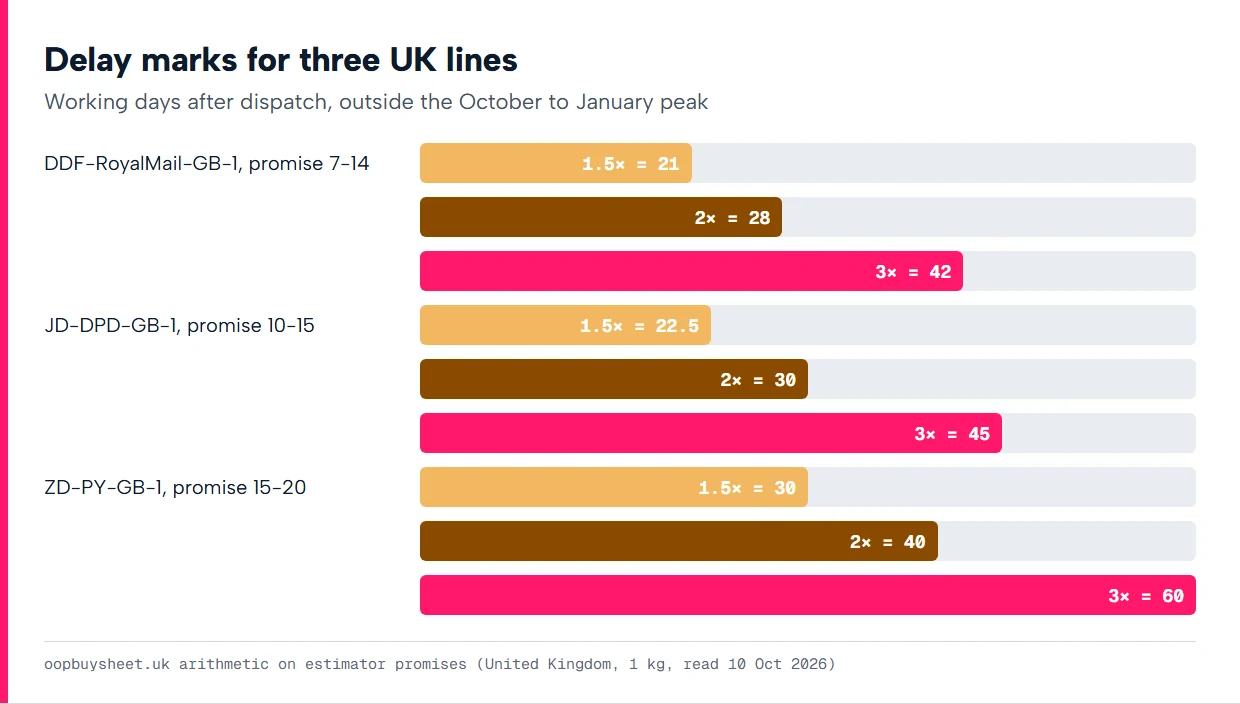
The arithmetic is simple, and the estimator gives you the number to multiply. DDF-RoyalMail-GB-1 promised 7 to 14 working days on 10 October 2026, so its marks fall at 21, 28 and 42 working days. JD-DPD-GB-1 promised 10 to 15, so 22.5, 30 and 45. ZD-PY-GB-1 promised 15 to 20, so 30, 40 and 60. Different lines on the same day can put the first mark three weeks apart.
What the marks are worth on one parcel
Delay Protection pays a share of shipping, never the value of the goods. On a 1 kg parcel on DDF-RoyalMail-GB-1, which the estimator priced at ¥118.32 on 10 October 2026, the three marks are worth ¥17.75, ¥59.16 and the full ¥118.32.
That puts the decision in proportion. On a cheap, fast line, delay cover protects a small sum. On a slower, dearer line, or a heavier parcel, the same percentages are worth more, and the October to January extension pushes every mark further out.
October to January adds ten working days
The Delay Protection note names a peak season, October to January, during which an extra ten business days are added to each of the timelines. On DDF-RoyalMail-GB-1 the marks move from 21, 28 and 42 working days to 31, 38 and 52. A parcel dispatched on 2 November and still unsigned on day 25 is late by any ordinary standard, but it has not reached the first peak mark.
The note does not say whether peak is judged by the dispatch date or by the date the mark falls. Our calendar uses the dispatch date, and says so.
Ninety days to apply
The same note says applications for delay compensation must be submitted within 90 days. It does not say 90 days from what. If you count from dispatch, a parcel that reaches its first mark on working day 21 leaves you roughly two months to apply; a parcel on a slow line in peak season leaves much less.
The general compensation article also mentions 45 days from shipping. Its relationship with the 90-day route note is unclear. Contact support when a problem occurs, ask which provision and starting event applies, and retain the response. Reporting early is prudent but does not resolve eligibility by itself.
When a late parcel turns out to be lost
Sometimes a late parcel is simply gone. The compensation-standards pages describe the order of payment: if you have received delay compensation and the parcel is then found lost, damaged or held by customs, the delay payment is deducted before the final compensation is made.
In practice this means two things. You will not be paid twice for the same parcel, and a delay claim does not close the door on a later loss claim. Keep the delay correspondence; it becomes part of the loss file.
What does not count as late
The delay rules exclude several situations by name. Force majeure in the origin, transit or destination country, including epidemics, bad weather and war, can mean partial compensation or none. A parcel held because the recipient did not deal with customs or pay tax is excluded. So is delay caused by a failed delivery or by not collecting the parcel in time once it reached a delivery point.
Read the carrier event literally. Out for delivery usually means the parcel is with a delivery route; it does not by itself prove a failed attempt or that the parcel is awaiting collection. Check for a separate attempted-delivery/collection notice and contact the carrier if the expected delivery does not occur.
Checking the promise before you buy
Because every delay mark is a multiple of the promised time, the promise you saw on the day you shipped is the number that matters. The estimator recalculates live, and promises change with the season and the carrier. Take a screenshot of your line's row, with its promised range and unit, on the day you submit. If the unit says working days, count working days; if it gives no unit, ask customer service which they mean.
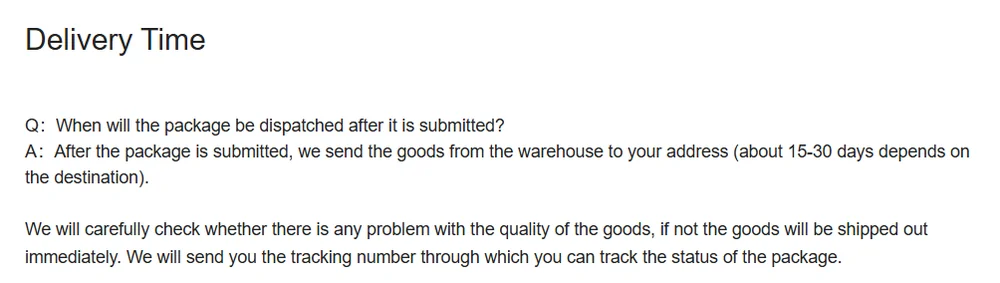
Oopbuy's own help pages give two older, generic figures for international transit: 5 to 12 days on one page and about 15 to 30 days depending on destination on another. Neither is the promise Delay Protection measures against. Use the line's own figure.
Next on the clock: the parcel reaches your door.
Signing for it